
By Mary Owen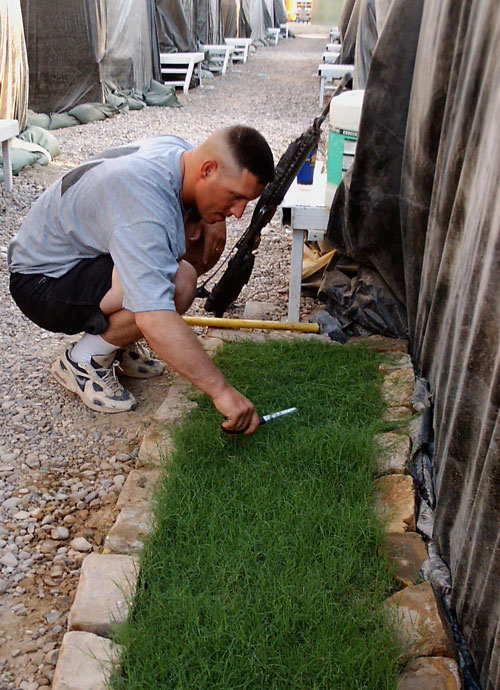
A photo taken of a local soldier planting a small plot of grass in Iraq is still making headlines.
“I’m honored and surprised as it was simply just a photo for me and my family that somehow has made its way around,” said Brook Turner, a Stayton soldier and focus of the photo that has made its rounds of in cyberspace, was published in an anthology of war photos, and now will be a part of an upcoming photo exhibition at the Museum of Fine Arts in Houston.
“We first saw the photo in a book, This is Our War, published in 2006 by GQ, of all things,” said Will Michels, a curator at MFAH and its upcoming exhibit, “War/Photography: Images of Armed Conflict and Its Aftermath,” scheduled to open on Nov. 11, 2012. Anne Wilkes Tucker is the primary curator at the museum.
Turner, a chief warrant officer (CW3) with the U.S. Army, planted the grass from seeds his wife, Kim, sent him when he was deployed in early 2004 out of Schofield Barracks to Iraq with his unit, the 1st Battalion, 25th Aviation. He dug a small area of dirt outside of his sleep trailer, lined it with bricks, and planted his seeds. Watering the plot several times a day using a plastic jug that he filled from a nearby shower trailer, the grass began to grow, only to be lost to a different kind of army – ants.
Turner bought seven small patches of sod – hardy, natural turf grass – from a local Iraqi vendor and replanted the area the ants had destroyed. It took root and fast became the conversation piece among his buddies and beyond. When his friend, SSG Mark Grimshaw, snapped him trimming his grass plot with scissors, neither had any idea of the attention it would attract.
The photo was published on page 160 in the GQ publication as “unknown photographer, unknown location, unknown title,” according to Michels.
“Credit is given to Joe Vargas as the contributor, but not the photographer, so I was pleased to see your article with better credits,” said Michels of Our Town’s first coverage of the grass in December 2009.
When Michels received an article about “Gardens During War Time,” which showed the photo. Intrigued, he Googled the name found in the photo credit and discovered the Our Town article.
“To be so random!” he said enthusiastically. “It will be an important addition to the exhibition, as it is one of the few that offers a smile and relief from the more expected pain and mayhem images.”
The Museum of Fine Arts exhibit began in 2002 with the acquisition of The Manfred Heiting Collection, a large compilation of some 4,200 photographs, including 30-40 related to war.
“The collection sparked our interest in researching all war photos in our own collection,” Michels said. “We started deciding where we were weak to try to strengthen it. During that self-study, the thesis for our exhibition surfaced.”
Neither he nor Wilkes showed any interest in a chronological look at battles “as seen thousands of times,” Michels said.
“The grass picture most likely will come in the section called ‘RR’ or it might be placed in ‘Camp Life,’” Michels said.
Most of the photos in the exhibit, chronicling wars from 1839 on and not limited to any specific battle, are not light-hearted, he added.
“This is one of the few humorous ones that made it through,” he said. “It just makes people smile.”
Turner’s photo will join ranks with Joe Rosenthal’s famous image, “Old Glory Goes Up on Mt. Suribachi,” showing five Marines and one Sailor raising the flag at Imo Jima. His work will go alongside those captured by photography greats, Larry Burrows (Vietnam), Roger Fenton (Crimea), Robert Capa (World War II), and James Nachtwey (active today in Rwanda and Somalia), according to Michels.
“It’s great that we’re including images like this with greats like that,” Michels said.
During his subsequent deployments in 2009 and 2011 to Iraq, Turner built small golf driving ranges, which gave troops a place to “swing some clubs and forget about the mission for a few minutes,” Turner said.
Fore Our Soldiers and Patriot Golf donated clubs and balls, he added.
Turner would love to attend the opening of the Houston Museum of Fine Arts exhibit on Armistice Day next year.
“If will probably be difficult, but the offer is fantastic!” said Turner, who now lives with his family in Hawaii and recently returned from his third deployment to Iraq.
For more information on the Museum of Fine Arts upcoming exhibit, visit www.mfah.org.
