By Mary Owen
Sharing the gospel goes hand-in-hand with Dr. Debbie Eisenhut’s medical skills.
Instrumental in working to solve Liberia’s Ebola outbreak, the local surgeon had no idea how important both would be when she went to work last year at ELWA (Eternal Love Winning Africa) Hospital in the capital city of Monrovia. Eisenhut is a medical missionary with SIM, an organization that has more than 1,600 missionaries in more than 50 countries worldwide.
“Being a part of the Ebola response has been stressful,” said Eisenhut, who was raised in Aumsville, graduated from Cascade High School, and is a life-long member of Bethel Baptist Church.
“Liberia has been through a bad civil war,” she added. “People are traumatized. It’s very challenging.”
Time Magazine recently named the Ebola fighters as its Person of the Year, highlighting ELWA’s director Dr. Jerry Brown on its cover.
“People doing the heavy lifting, like Jerry Brown, deserve to be recognized,” said Eisenhut, who researched the Ebola virus, trained staff and treated the disease at ELWA.
Although instrumental in ELWA’s Ebola care, Eisenhut credits the work of numerous individuals in helping to curb the spread of the disease, including doctors, nurses, scientists, hospital staff, ambulance drivers and even those who bury the dead.

“If they didn’t do their part, it would bring the danger to us,” she said. “We can’t turn our backs. Jesus wouldn’t turn his back. We need to help.”
Eisenhut, who ran the hospital’s response unit, helped care for two others mentioned in Time’s article: Dr. Kent Brantly, sent to SIM by World Medical Mission, a branch of Samaritan’s Purse, and SIM medical missionary Nancy Writebol. Both medical workers were subsequently treated in the United States and survived the disease, which, according to the Centers for Disease Control, claims up to 72 percent of patients in Liberia, Guinea and Sierra Leone. Nigerian fatalities are lower at about 46 percent, the CDC reports.
When Eisenhut first arrived in Liberia in April 2013, she was the only Western-trained medical professional at the hospital. Six months later, Dr. Brown, sponsored in his surgical training by Dr. Mark Snell of Bonney Lake, Wash., came to work at ELWA. Brown committed to five years at ELWA following his residency. He eventually was appointed by SIM Liberia as medical director, taking over the hospital’s Ebola unit after Eisenhut returned home in August.
About the same time as Brown’s arrival, Dr. John Fankhauser with SIM and Dr. Brantly also joined the ELWA crew.
“We heard in March that there were six people in Foya, in northern Liberia, who died from Ebola,” Eisenhut said. “These people are very mobile. We knew Ebola would come our way, and wanted to prepare.”
Eisenhut began to research Ebola, which in its early stages can look like any number of diseases common to West Africa, including malaria, typhoid fever, meningococcemia and other bacterial infections.
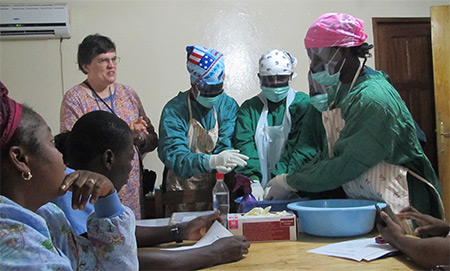
Her findings resulted in ELWA separating patients from the rest of the hospital population to be treated by staff wearing protective gear.

“We first set up a treatment unit in the chapel,” Eisenhut said. “We trained staff on how to triage people so we didn’t have Ebola victims in the ER. That has paid off. We are the only hospital that had no staff die from Ebola contracted from a patient.”
Eisenhut and Brantly were the first to suit up and care for patients at ELWA’s chapel. With growing numbers of EBOLA cases, the chapel soon was replaced by a treatment unit set up across from the hospital, Eisenhut said.
“We are the only hospital that has remained open, except for two short closures,” she said. “Most other hospitals remain closed because they have lost staff. God has been very gracious to us.”
Currently, ELWA is taking obstetrics patients and a few more medical cases, but surgeries are still limited, Eisenhut said.
“Ebola is so endemic in the community, it’s not even safe to go to the hospital,” she adds. “People are dying of regular things, like a broken arm or ruptured appendix.”
Eisenhut said Liberia has no cancer treatment or cardiac care.
“We haven’t even been able to find nitroglycerine in the pharmacies, no morphine,” she said. “There used to be one orthopedic surgeon, but I doubt if he is there now. There are only a half dozen dentists and surgeons in the whole country. No neurosurgeons, radiologists or pathologists. There is only one CT scanner and no one to read the scans. That’s the tragedy. It’s mind-numbing to think about it too much. You can just get overwhelmed.”
Compared to the rest of Africa, Eisenhut said Liberia’s offerings are very basic. Much of the limited equipment disappears, and other challenges hinder hospitals in treating patients, she said.
“Part of what is so disheartening is the root problem is a spiritual problem,” she said. “The main reason we are there is for spiritual transformation. Unless people accept Jesus and change their hearts, all the care, all the money in the world can’t help.

“We are all sinners,” she added. “We all need Jesus. We all need salvation. We can’t ignore this human need, whether there or here. As my field director says, ‘We have to keep the main thing the main thing.’”
Eisenhut said the number of Ebola cases are easing in Liberia but worsening in neighboring Sierra Leone. What’s needed is a combination of external aid and behavior changes by those living in those countries to further curb the spread of the disease, she said.
“We can’t let up,” Eisenhut said. “People need to be informed of what’s happening there and support the efforts. They need to open their hearts and even their wallets. And they need to not only support people who are going to help, but welcome them when they come back.”
For her part, Eisenhut teaches others about Ebola, most recently in Atlanta for 76 public health officers going to Liberia to run treatment centers set up by the U.S. military.
“There is no approved or proven care yet, but some experimental treatments show promise,” she said. “Two vaccines are going to be trialed soon. Tests need to be done. This may take a few months, even years.”
Meanwhile, Eisenhut said ELWA needs revitalizing, both with equipment and procedures.
“It’s an exciting goal, but very challenging,” Eisenhut said. “Changes are hampered by war and culture.”
For her part, Eisenhut is focusing on getting better hospital care for Liberians.
“There’s not much surgery going on right now, but there are other things I can do,” she said. “If the hospital staff is there but not really engaged in medical care, this might be a good time to teach basic medical and nursing classes, and also Bible classes.”
After teaching Ebola-treatment classes stateside, Eisenhut hopes to return to Liberia in the next few months.
“I did have a little vacation,” she said. “It’s nice to be home for a while, but I need to get back.”