As a child, Joyce Heinke had little exposure to growing flowers.
“The only one in my family who was interested in growing things was my mother,” Heinke recalled. “But we had a small well and there was little extra water. So, she grew only a few things like bachelor buttons and hollyhocks… I remember trying to grow bulbs, but gophers ate them. I actually watched a tulip sway from side to side accompanied by crunching as it slowly sank into the ground.”
Despite these early struggles, Heinke developed a love for blooming things and now, with a garden of her own, she grows 40 varieties of roses, 60 of peonies, over 100 dahlias, 75 clumps of named iris, a huge number of perennials, some potted annuals and over 400 orchids.
“Recently I have gotten into growing native plants,” she added. “I took out my front yard lawn and made it into a pollinator garden.”
In other words, Heinke knows a thing or two about cultivating a flower garden, including how to get started.
Decide What to Grow
“First you need to understand your climate, that will greatly limit what you can grow,” Heinke said. Then, “one needs to decide if they want a cutting garden or more of a cottage garden? Will it be mostly perennials or annuals? All types of plants or only natives?”
Because each plant has its own needs when it comes to sunlight, soil acidity and drainage – all of which need to be established before a first-time gardener ever breaks ground.
“In addition, how much time are you willing to spend caring for that plant?” Heinke asked. Because some plants – like dahlias – require extensive care.
“Dahlias like to be cut off at ground level, covered with plastic and then dirt for the winter,” Heinke said. Not a viable choice for someone who is looking for a hands-off plant.
It’s also worthwhile considering how you want your garden to look during each season.
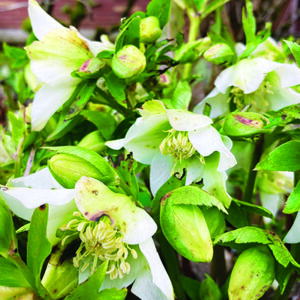
“If you choose carefully, you can have plants bloom year-round,” Heinke said. “Hellebore and Daphne, snowdrops some varieties of camellia, mahonia, pansies, sarcococca, and primrose bloom in
late winter. Some of these extend into spring. Some spring blooming plants are… lady’s mantle, nodding onion, anemone, columbine, red flowering currant, etc. Some summer blooming plants are yarrow, hollyhock, milkweed, pot marigold, beautybush, campanula, iris, and clarkia. A few fall blooming plants are dahlias, chrysanthemum, echinops rito, California poppy, Canada goldenrod, and coneflower. Roses bloom in spring, summer and fall.”
Preparing the Garden
Once you’ve decided what to grow it’s time to decide where each plant will thrive.
“One needs to observe the area over enough time to know where there is shade, how deep it is, and how much of the day…” Heinke advised. “One should have some idea of the soil’s pH. Is the soil clay, sand or a loam? Will the plant need to be irrigated and how much? Does it need to be on a raised bed or row? How big will the plant grow to be? Will the plant fit in a few years? Don’t depend on pruning to keep it in check.”
Once all these aspects have been determined and the area mapped out it’s time to begin preparing for planting.
“You will want to be sure to kill all weeds in a site and work it up before planting anything,” Heinke said, referring to the act of amending the soil with a type of compost that matches each plant’s specific needs for things like nitrogen and carbon.
“Compost is about 7 pH, which is good for most plants, but not all,” she confirmed. “What, when, how much to fertilize varies by plant. Also, the type of fertilizer varies. You fertilize bulbs when you plant them and when they come up in the spring. Iris are fertilized in April and four weeks after blooming. Peonies are fertilized when they are six inches tall. Roses are fertilized every six weeks starting in spring until August.”


Planting
Now that the soil is ready, it’s time to plant. But it’s important to remember that not every flower should be planted in early spring.
“[I]n the spring I would plant most perennials like Lily of the Nile, dahlias, Agastache, columbine, Basket-of-Gold, clematis, roses, delphinium, gaillardia, bee balm, poppy, asters, astilbe, campanula, chrysanthemum, foxglove, echinacea, gaillardia, helleborus, heuchera, Shasta daisies, rudbeckia, veronica, etc.,” Heinke listed. Adding, it’s best to avoid plants with a bulb as those should be planted in the fall.
“[A]lthough you might want to order them in the spring,” Heinke pointed out. Adding that now is a wonderful time – with so many bulb plants preparing to bloom, including daffodils, iris and tulips – to visit a farm like Schreiner’s Gardens in Salem or the Wooden Shoe Tulip Farm in Woodburn to learn more about spring bulbs and to find inspiration.
Because flower gardening can be both fun and inspiring – if the gophers stay away.