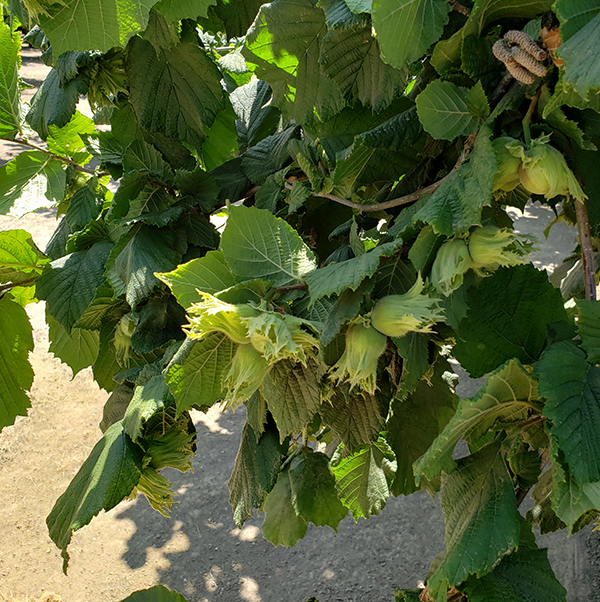
Wilco has shed its hazelnut business amid price slumps that have roiled the market for the nut, 99% of which is grown in Oregon.
The decision puts in limbo the massive 120,000-square foot Hazelnut Growers of Oregon processing facility in Donald. The plant opened to great fanfare in 2018, but it is now for sale, Wilco officials said.
Wilco, the Mount Angel-based agricultural cooperative, finished its payments to growers for the 2023 crop on June 12 and did not accept a 2024 crop. Dozens of layoffs have been reported, although Wilco marketing executive Jake Wilson said “HGO staff levels adjust each year based on crop size and seasonality. Some team members have moved to Wilco teams, the actual change in team members will not be fully known until a sale finalizes.”
When the Donald plant opened in August 2018 Oregon growers were producing approximately 55,000 tons per year and getting about $1 ,750 per ton, although that figure represented a steep drop from the $3,500 figure for 2014, according to data compiled by Pacific Agriculture Survey. Meanwhile, supply has skyrocketed amid a surge in plantings. It has gone from that 55,000 tons in 2018 to approximately 95,000 tons in 2023 – and the price has fallen to about $1,250 per ton.
When asked about the free fall of hazelnut prices, Wilson noted that “similar to other agriculture crops, [hazelnut] prices go up and down depending on a variety of reasons. Each year’s crop has its own story and reasons for where the pricing comes in.”
However, John Bowersox, Wilco’s president and CEO, had a blunt take on the situation when he spoke with The Capital Press “for a number of years, we’ve really struggled to make the hazelnut operation profitable.”
Ben Coleman, chairman of the Wilco Board of Directors, added in a Wilco press release “we recognize the importance of the hazelnut industry to the greater Willamette Valley region, and we are disappointed we have not been able to achieve an acceptable level of performance with the Hazelnut Growers of Oregon business.”
Wilco and Pacific Agricultural Survey, which uses high-tech tools to provide information on acreage and other data to the Oregon hazelnut industry and other agricultural clients, both indicated that the loss of the capacity of the Donald plant should not affect the ability of growers to get their nuts processed.
“In general,” Mike McDaniel, owner of Pacific Agricultural Survey, told Our Town, “growers will have to switch to one of the remaining hazelnut processing companies in the valley. The main options are George Packing Co./Northwest Hazelnut Co., Willamette Hazelnut Co., and Denfeld Nut. There may be one or two much smaller operations out there but these three now represent almost all the market share for the industry. All the major companies have receiving stations set up across the valley where growers can bring their harvested nuts for collection and weighing.”
Bowersox said in a statement issued by Wilco that “while this divestment means change, it also presents an opportunity for Wilco to refocus our efforts as an agricultural cooperative, investing in areas that will increase our long-term growth prospects, and enhance our ability to serve our members.
“Wilco is financially sound, and we are optimistic about our future. By taking this action, we will emerge better positioned to fulfill our purpose as a member-owned cooperative that strengthens agricultural and rural lifestyles.”
What happens to growers and the hazelnut industry moving forward is another matter. It takes a hazelnut orchard approximately four years to mature and produce a crop. That means that the approximately 5,000 acres planted in Oregon in 2020 and the 6,000 or so in 2021 will add to that 95,000 tons of supply in the next year or so, according to McDaniel’s data.
Wilco’s Wilson agreed that there “possibly will be a larger crop for 2025, but [production will be] more consistent after that as there have been less new plantings done in the past few years.”
“Wilco’s decision to divest from the HGO business is to focus on the supply businesses like retail and energy,” he said. “Wilco has invested millions into the hazelnut industry and HGO business over the years. Wilco as a whole is profitable, financially sound, and poised to grow in the coming years.”
About Wilco
The Wilco agricultural cooperative was formed in 1967 when five cooperatives merged, although the company’s roots go back to the 1930s. Today, Wilco has 26 farm stores, a bulk energy business and is part of the Valley Agronomics’ Joint Venture. There are approximately 3,000 members and the farm stores serve more than 500,000 customers throughout Oregon, Washington and California. The company is based in Mount Angel.
About Hazelnuts
Hazelnuts, also known as filberts, are used as a snack food, in baking and in breakfast cereals such as muesli as well as chocolate bars and hazelnut cocoa spreads such as Nutella. They are also used in Frangelico liqueur and hazelnut oil, which can be used for cooking or as a salad or dressing oil. Turkey is the world’s largest producer of hazelnuts. Virtually all of the U.S. crop is grown in Oregon, with Marion County (26,127 acres in 2023), Yamhill County (19,111 acres) and Linn County (12,659 acres) the largest producers.
Sources: Pacific Agricultural Survey, Wilco, Wikipedia