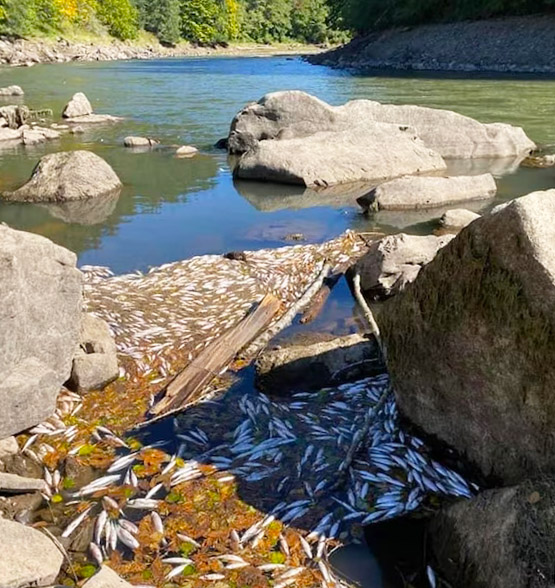
The drawdown of Green Peter Reservoir in 2023 and 2024 and the resulting downstream damage on the South Santiam River and its watershed has led to a lawsuit.
The cities of Lebanon and Sweet Home have sued the U.S. Army Corps of Engineers for $37 million, alleging that the Corps mismanaged the work by failing to implement any sediment control measures. Corps officials did not respond to a request for comment from Our Town, not surprising given the federal government shutdown that has slowed or halted much governmental activity.
The lawsuit and the Corps’ drawdown actions are being watched closely throughout the Willamette Valley. The Corps is proposing a similar fish-passage-related drawdown of Detroit Lake on the North Santiam River for the fall of 2026, with possible effects including recreation in the Santiam Canyon and Detroit as well as drinking water in Salem and Stayton. The Corps originally proposed a 2025 drawdown but postponed it a year to gather more public feedback and draft a new environmental impact statement (EIS).
The Lebanon and Sweet Home said the drawdown increased the sediment load in their water treatment facilities – changes that the systems were not prepared for – leading to higher operational costs, equipment damage and expensive pre-treatment upgrades.
Drawing down the Green Peter reservoir began in late November, 2023, an action ordered by U.S. District Court Judge Marco A. Hernandez.
It led to the deaths of thousands of kokanee, with photos of the thousands of dead kokanee all over the news and social media. The drawdown also impacted water quality as far downstream as Albany and Millersburg. Lowering the water level below the normal winter pool level was intended to allow young fish to migrate into the river without passing through power turbines at the dam.
Sweet Home claims that the high turbidity levels created a “sludge blanket buildup” in the city’s facility and is seeking $11 million in damages. Lebanon is seeking $26 million. Officials said in a report by KOIN-TV, that these costs reflect anticipated upgrades for water treatment facilities to handle future drawdowns and ensure long-term water safety.
Stayton officials have concerns about keeping its slow sand filtration ponds operating amid high turbidity (sediment in the water). When the sediment load in the water gets too high the filters either do not operate as efficiently or have to be shut down.
“We have been working on this consistently,” Stayton City Manager Julia Hajduk told Our Town. “We have been meeting with staff and representatives at the state and federal level to convey our concerns and the risk to our water system.
“City representatives will meet with the U.S. Army Corps of Engineers in early November to discuss both their plans and the city’s ongoing efforts. During these discussions, Stayton will continue to advocate for the resources, both time and funding, needed to implement the critical risk-reduction strategies.”
Stayton’s strategies are:
Avoidance: Eliminating exposure through regulatory, political, and legal engagement to prevent actions the USACE could undertake that would threaten the water supply.
Minimization: Reducing the likelihood of interruption by developing alternative-source water options and evaluating pre-treatment methods to strengthen the performance of existing slow-sand filtration system.
Mitigation: Lessening the potential impact through improved operations, demand management, and continued collaboration with the Stayton community.
Stayton also is working on water-reliability initiatives, including, Hadjuk said, establishing ties with neighboring communities; redeveloping existing wells to maximize production; and constructing new water mains to support an aquifer storage and recovery system.
The Corps is trying to comply with a National Marine Fisheries Services biological opinion of Dec. 26, 2024, that mandated the Detroit drawdown to ease fish passage for endangered spring Chinook and winter steelhead stocks.
The biological opinion called for the drawdown at Detroit to its lowest level ever, 1,395 feet above sea level (1,558 feet above sea level is full pool) as part of a series of measures aimed at fixing the water temperature and fish passage. Corps officials told a public forum in Detroit that the Green Peter drawdown was much more extensive than the one planned in Detroit and that the Green Peter drawdown exposed more than four times as much sediment as Detroit’s will. Although the schedule remains in flux it seems likely that multiple years of drawdowns will be required.
Elsewhere in the Santiam Canyon, Aumsville, Mill City and Sublimity use well water, which is unlikely to be affected by drawdown turbidity.
Gates, Jefferson, the Lyons-Mehama Water District, the Santiam Water Control District and Turner face the possibility of poor water quality in the North Santiam River overwhelming their water treatment systems. Detroit and Idanha are above the reservoir dams and won’t be affected.