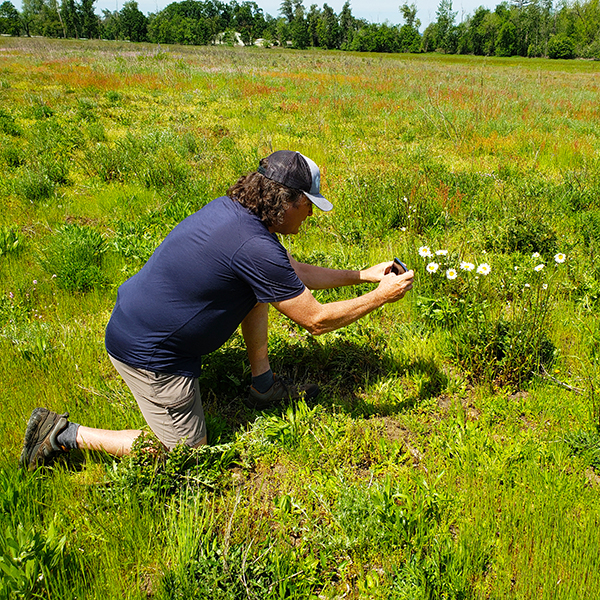
“This is cool,” says Travis Williams. “This is a bloom I haven’t seen out here yet.”
Williams is in his element. A long-time environmental activist with the Willamette Riverkeepers, he is now engrossed in a new initiative, the Willamette River Preservation Trust.
Williams, a Scotts Mills resident, is the founder, CEO and president of the trust, which closed on buying its first property last fall. The 270-acre Oak Meadows Natural Area, located about halfway between Stayton and Scio, was purchased for $295,000.
The property, Williams said, is wet prairie habitat and he is an excellent guide. On May 9 he gave a personal tour to Our Town, showing off the parcel’s flora, fauna, riparian areas and pollinators.
Clad in shorts and sporting a hat advertising OSU’s Hatfield Marine Science Center, Williams leads the way at a brisk space, stopping here and there to point out a wildflower, note a bird song or tell a story about the parcel.
Oak Meadows Natural Area is not Silver Falls or Yosemite. It doesn’t overwhelm you with natural beauty. It is a quieter, more subtle avenue into nature. Off in the distance, below wisps of spring clouds, you see what appears to be just a grass field. But as you get closer – or more accurately as you follow and listen to Williams – you see monkeyflowers here and camas there and sea blush over here and take part in Williams’ search for Bradshaw’s lomatium, a rare flower that only exists in the Willamette Valley and Southwest Washington.
“The paramount thing for us is protecting the habitat while still doing organized trips so people can enjoy the site and learn about it,” he said.
No major amenities are planned for the site except perhaps a kiosk with interpretive markers. Williams is particularly enthusiastic about the way Oak Meadows allows you to see the seasons reflecting nature’s annual cycles. Just as crocuses give way to daffodils then tulips and irises in the bulb world, out at Oak Meadows something is always coming into season or fading or providing surprises.
“Things are always changing here,” Williams said.
He has installed “game cams” throughout the parcel. Wild turkeys, lots of deer, coyotes and gray foxes are common, although elk also have been seen.
“A while ago one of the game cams came up with a photo of an elk,” Williams said, “and a month later a whole herd of females came through, crossed the road and moved on.”
A huge swath of prairie runs down the center of Oak Meadows, with the north rim dominated by an oak woodland with sword fern and Oregon grape. A creek runs through the south end amid a marshy riparian corridor that includes ash, alder and cottonwoods.
Evidence of “wet prairie” is everywhere, with bare, dry plots giving evidence of recently dried pools. By following the curving dry sections of what was a “temporary stream” from the higher elevations in the center of the pool, and winding down to the creek, you can imagine how wet Oak Meadows can get.
Williams said that it is only in the past few weeks as things have dried up a bit that he has not brought muck boots with him to the site.
The Natural Resources Conservation Service has done some seeding on the parcel and also organized a controlled burn to help cut down the invasives last summer. Mowing the perimeter to help with fire lanes is about the only other manmade intrusion into Oak Meadows.
“There is always a little bit of trial and error with a site like this,” Williams said.
ABOUT LAND TRUSTS
A land trust or land conservancy is a community-based, nonprofit organization that works to permanently conserve land. In some cases, land trusts acquire land outright. They also partner to conserve land that remains the property of willing landowners using a tool called a conservation easement. Land trusts also manage or restore land once it has been conserved and often provide recreational opportunities.
KEY GOALS OF TRUST
• Purchase or receive donated ecologically healthy lands for permanent protection.
• Purchase or receive donated land in need of habitat restoration where we can then take restoration action.
• Enable people to learn about these places via educational trips by land and water (walking tours, canoe and kayak trips and more).
• Create access to these places, when it makes sense, for low-impact recreation. This includes public opportunities for hiking, bird watching, and just enjoying the peace and quiet of nature.
HOW TO GET INVOLVED
To volunteer, participate on a tour, or contribute to the Willamette River Preservation Trust, go to wrtrust.org or send a tax deductible check to Willamette River Preservation Trust, PO Box 117, Scotts Mills, OR 97375.